The operating system for producing SEO content at scale.
ContentOS is a multi-tenant platform built for the real needs of an agency running a dozen industry blogs at once. It combines keyword research (GSC/GA4/Merchant), an AI pipeline with 5 models and auto-publishing to 6 Magento instances. The flow is configurable step by step — which model does the research, which writes the intro, which edits. Brand context is injected into every prompt automatically, so an article about pellets for the Austrian market never talks about Polish subsidies.
Status
● Production live
Tenants
8 · multi-tenant with RLS
AI models
5, swappable live
Integrations
9 (Magento, GSC, GA4, FB)
Stack
Next.js 16 · Inngest · Supabase
AI pipeline, step by step
Seven stages. Five models. One click to publish.
For every step in the flow you pick a specific provider, model and prompt. Perplexity handles research because it works in real time, Gemini drafts because of the long context, Claude edits because the prose reads naturally, Higgsfield makes the featured image. This is not an "auto-writer" — it is a pipeline you shape around your own product.
01
RES
Research
Perplexity Sonar
→
02
DRAFT
Draft
Gemini 2.5
→
03
EDIT
Editing
Claude Opus 4.6
→
04
SEO
SEO meta
GPT-5
05
LINK
Internal linking
embedding similarity
→
06
IMG
Featured image
Gemini + Higgsfield
→
07
PUB
Publishing
Magefan API + webhook
~18 min
Full pipeline · from brief to published
8 domains
Configured in parallel
Site Context
Auto-injected into every prompt
Product numbers
What ContentOS does in the background when you click "publish".
Every number comes from production code — verifiable on a call under NDA. As of 2026-05-09 (local agent report).
8
Tenants in production
PL · DE · AT
36
Tables in Postgres
multi-tenant with RLS
5
Swappable AI models
claude · gemini · gpt · grok · perplexity
9
Integrations
magento · gsc · ga4 · fb · webhook
27
Dashboard pages
+ 32 API endpoints
72,506
Lines of TypeScript
393 files · 318 commits
Dashboard
What you see after logging in.
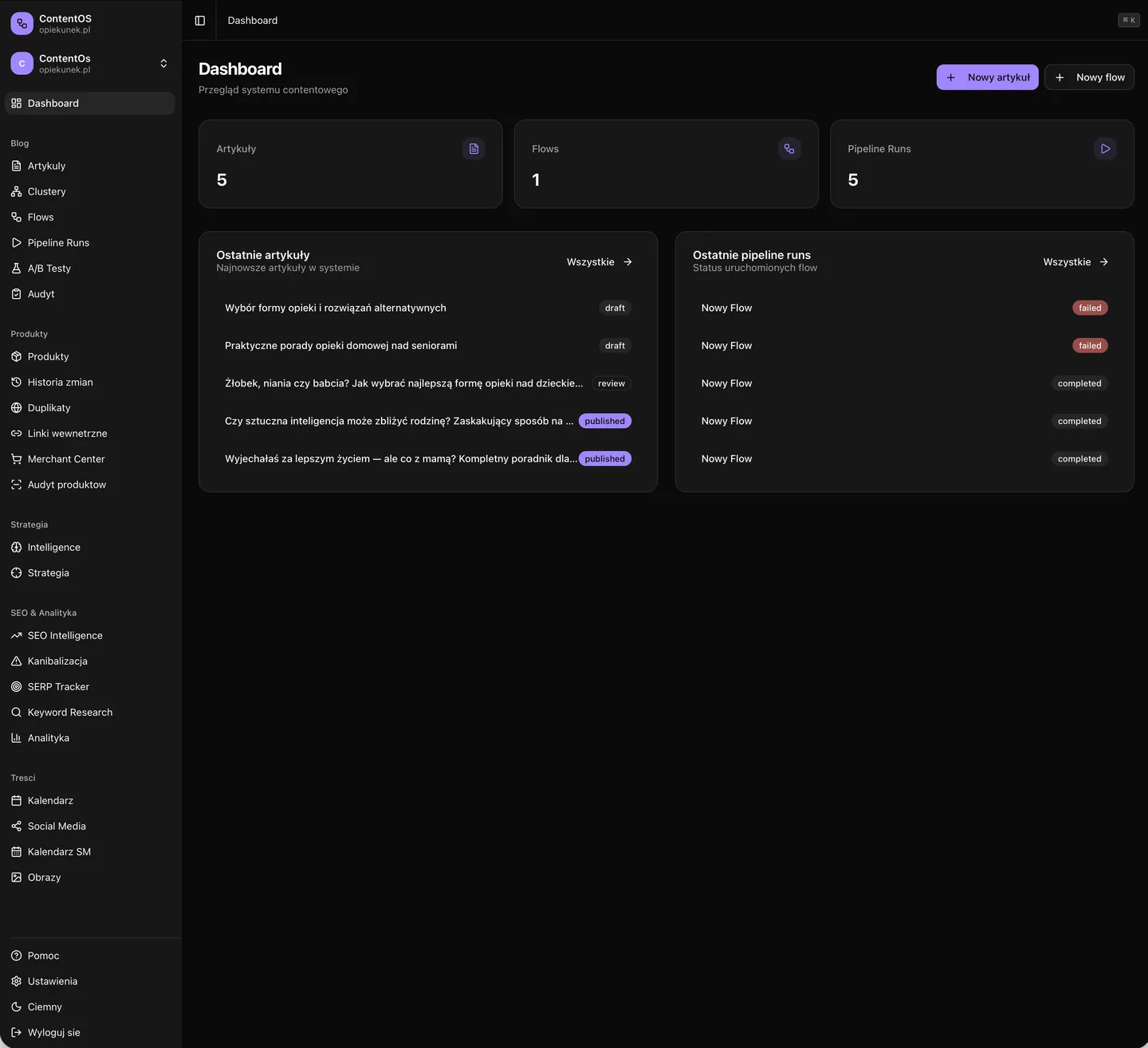
Tenant switcher at the top (8 to choose from). Three key metrics: Articles, Flows, Pipeline Runs. Below that, the latest articles with their status (draft / review / published) and the latest pipeline runs (completed / failed / running) — you know immediately what needs attention.
contentos.studioapps.pl/dashboardDashboard
SAMPLE DATA
Dashboard · tenant switcher · 5 articles · 1 flow · 5 pipeline runs · status per article
Articles
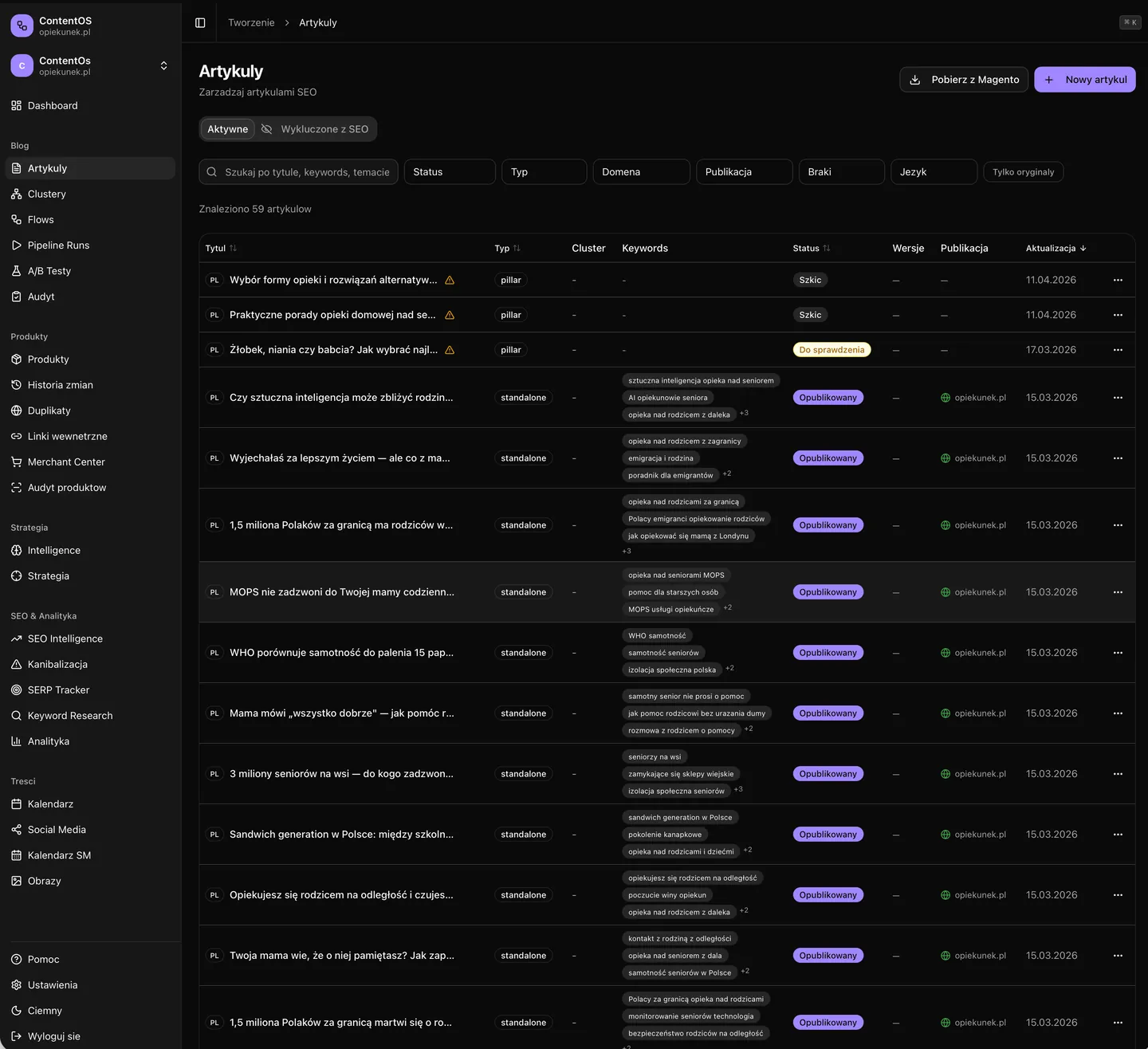
58 SEO articles. Cluster, keywords, status, language, versions.
The full article table for a single tenant. Filters: active / excluded from SEO, status, type (pillar / standalone), domain, publication, gaps, language. Every article has its cluster, keywords (tags), version history, publication date and last update. Export to Magento in one click.
SAMPLE DATA
58 articles · cluster · keywords · status · versions · publication · export to Magento
Flows Editor
Pipeline visualiser. Drag-and-drop. Pick the AI for each step.
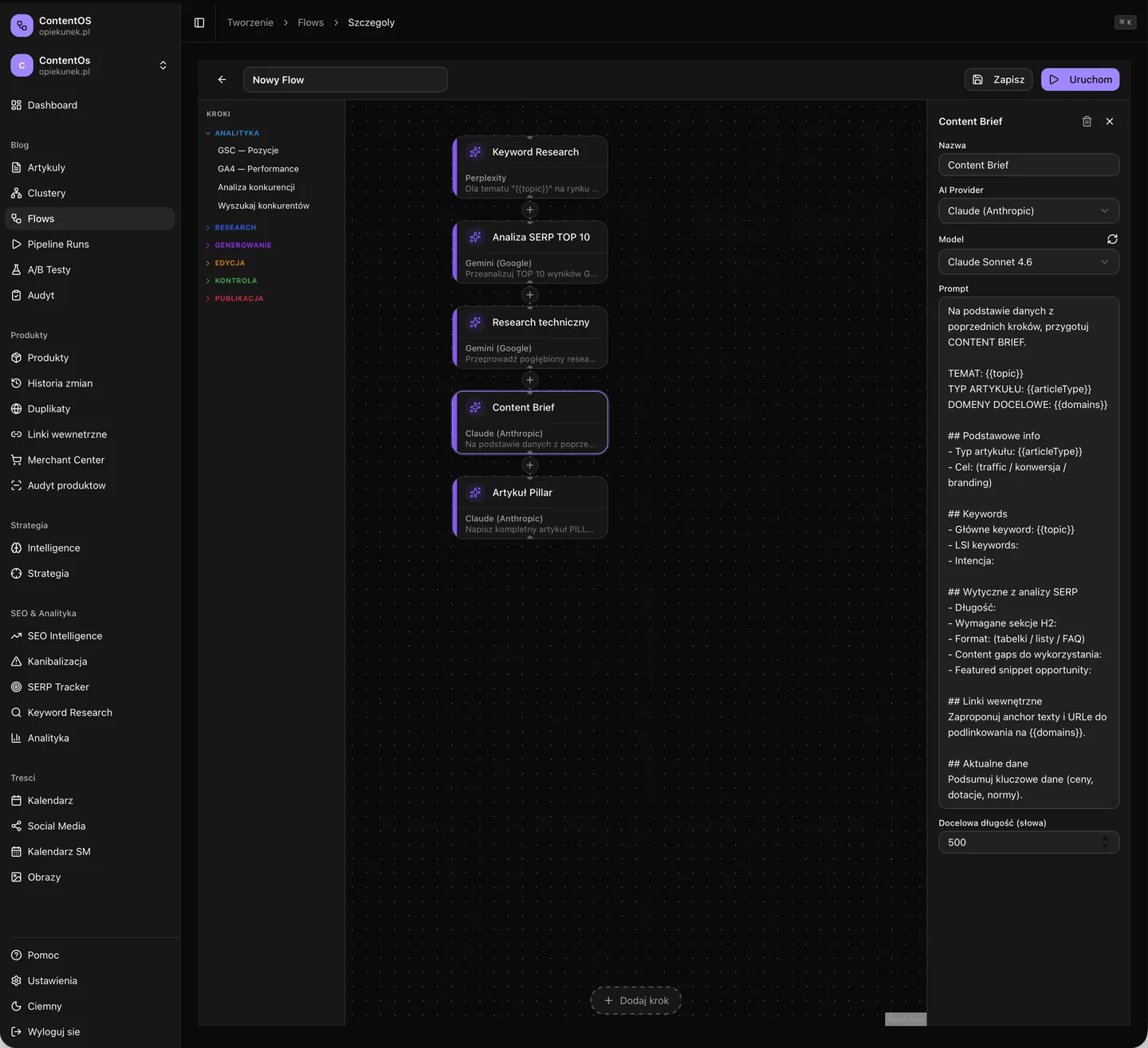
The content flow editor: Keyword Research → TOP 10 SERP analysis → Topic research → Content Brief → Pillar article. Every node has its own provider (Perplexity, Claude, Gemini) and a specific model — you change it in the right-hand sidebar. A custom prompt per step, with brand context auto-injected.
SAMPLE DATA
"SEO Pillar" flow · 5 steps · provider + model per step · custom prompt + brand context
Intelligence Engine
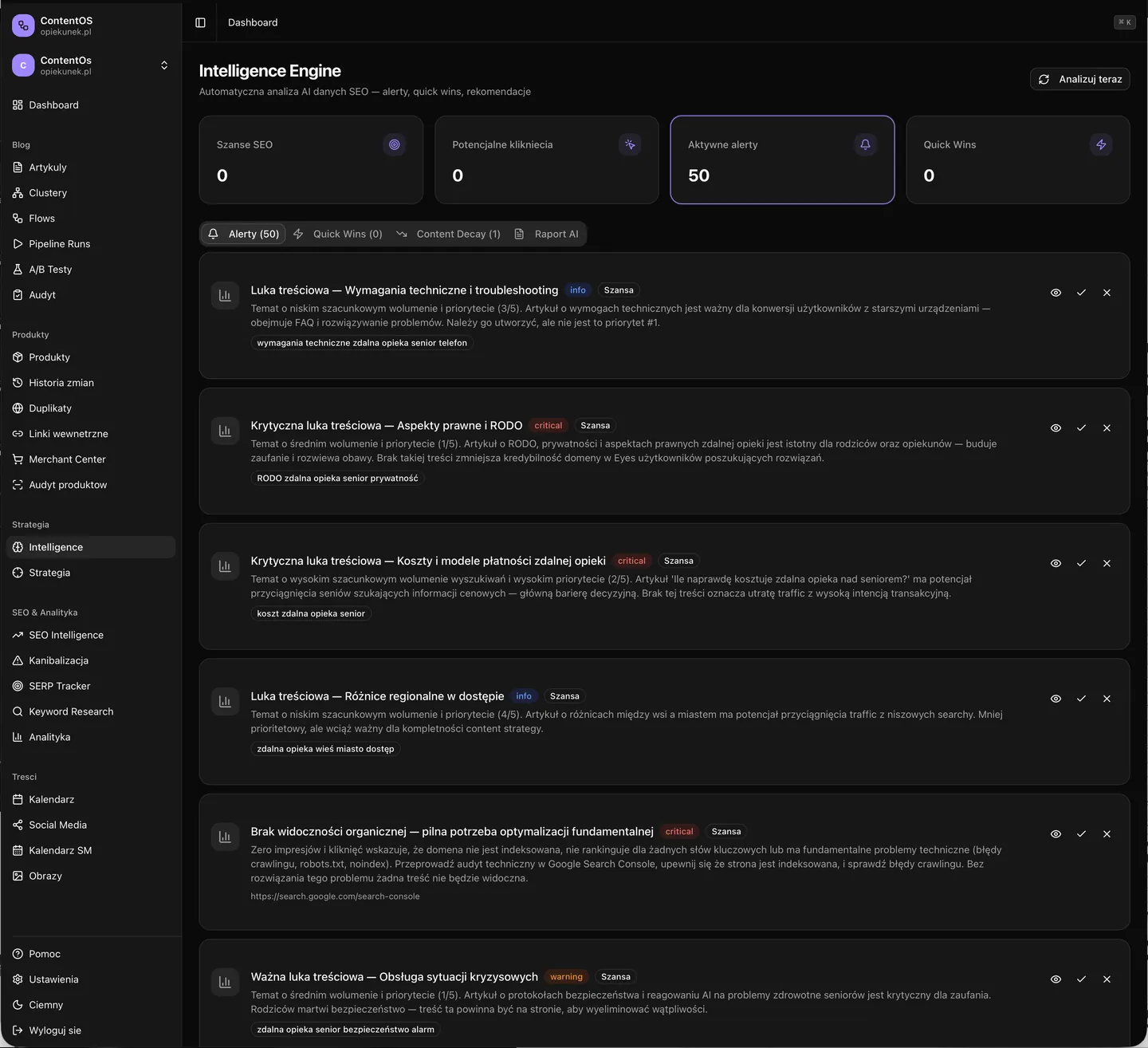
AI analyses 58 articles and tells you where the content gaps are.
The engine scans the existing content plus GSC queries plus the competition and surfaces 50 active alerts: content gaps, critical omissions (GDPR, costs, availability), topics in content decay, an AI report on trending topics. Every alert is clickable → an article draft lands in the pipeline.
SAMPLE DATA
50 active alerts · content gaps · content decay · GDPR · trending topics from GSC
Strategy
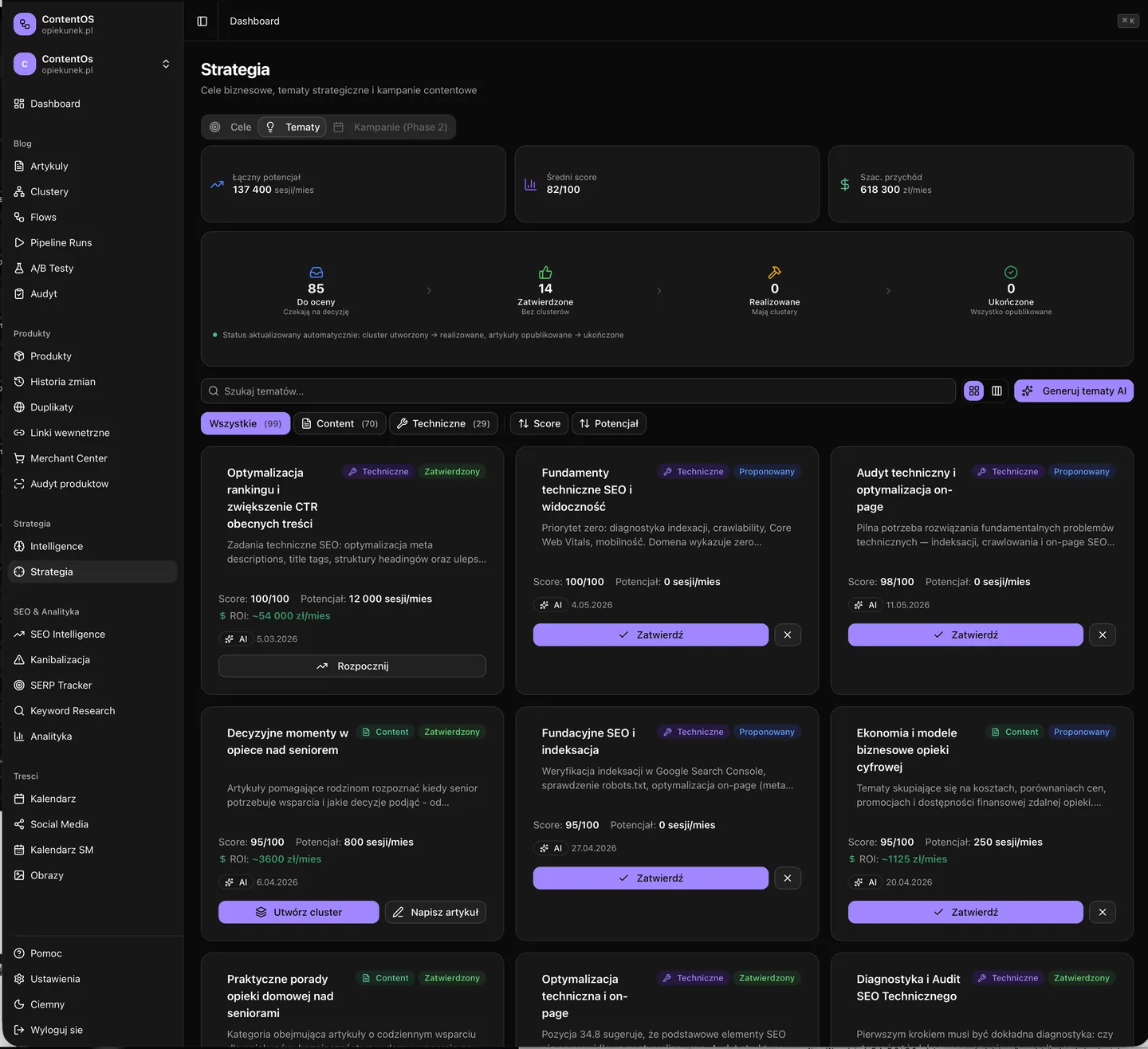
A content board. 99 topics. ROI per article.
An annual strategy with 99 strategic topics — each with an SEO score, traffic potential, phase (Content / Technical) and category. You click "Approve" → the topic goes into the pipeline. It takes "what shall we write today" out of the client briefing.
contentos.studioapps.pl/strategyStrategy · Board
SAMPLE DATA
99 annual topics · score · traffic potential · 85 to review · 14 approved · ROI per topic
Content Audit
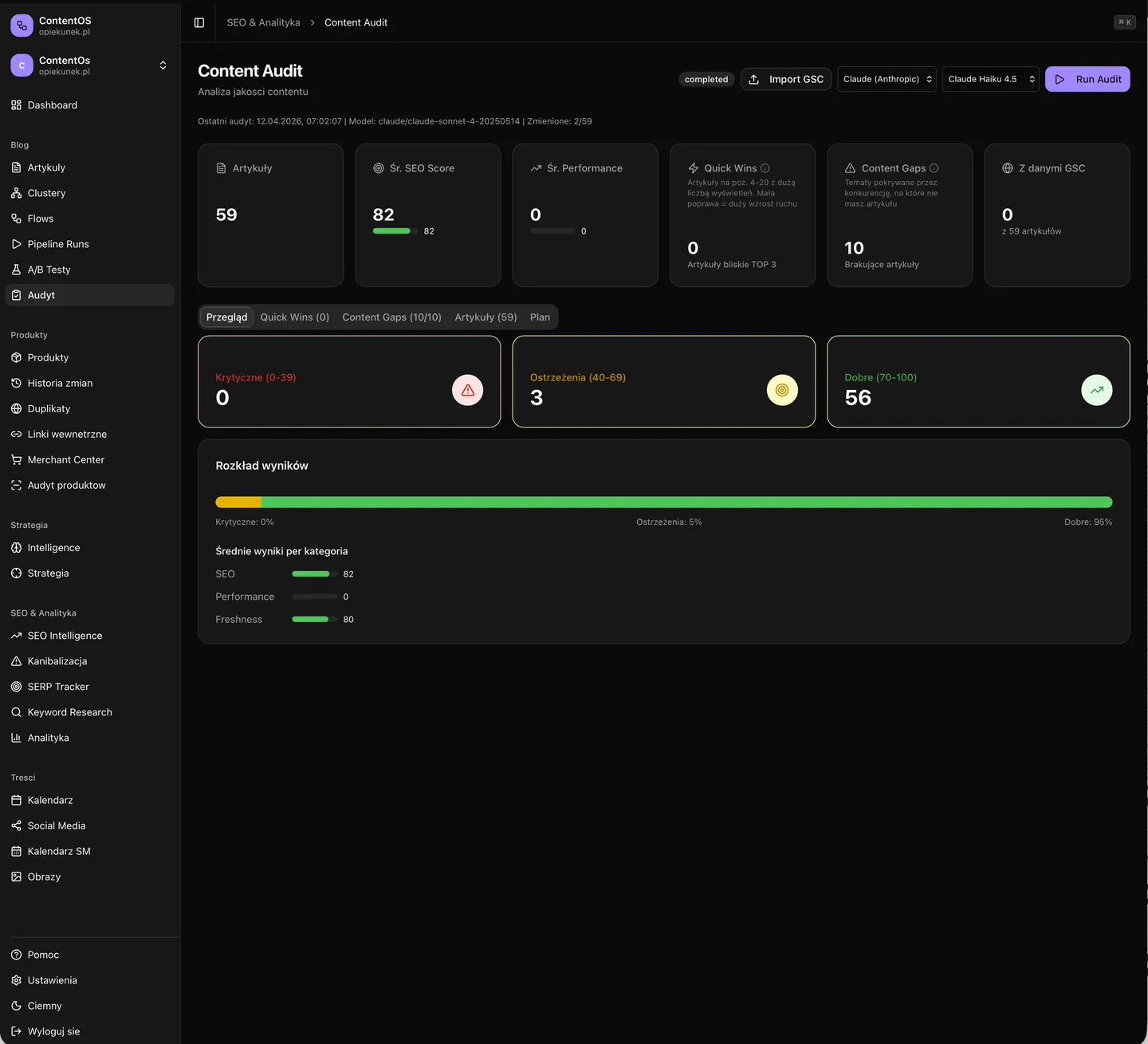
A quality audit of 59 articles. Score 82/100.
Quality analysis across the whole content set: SEO score, Performance, Quick Wins, Content Gaps. Data imported from GSC, automatic categorisation per article (Critical / Warnings / Good). Quick Wins = articles one position away from the top 3 — a concrete list of what to fix this week.
contentos.studioapps.pl/auditAudit · Content
SAMPLE DATA
59 articles · SEO score 82 · 0 quick wins · 10 content gaps · 56 good · 0 critical
Products + audit
Magento products under SEO control.
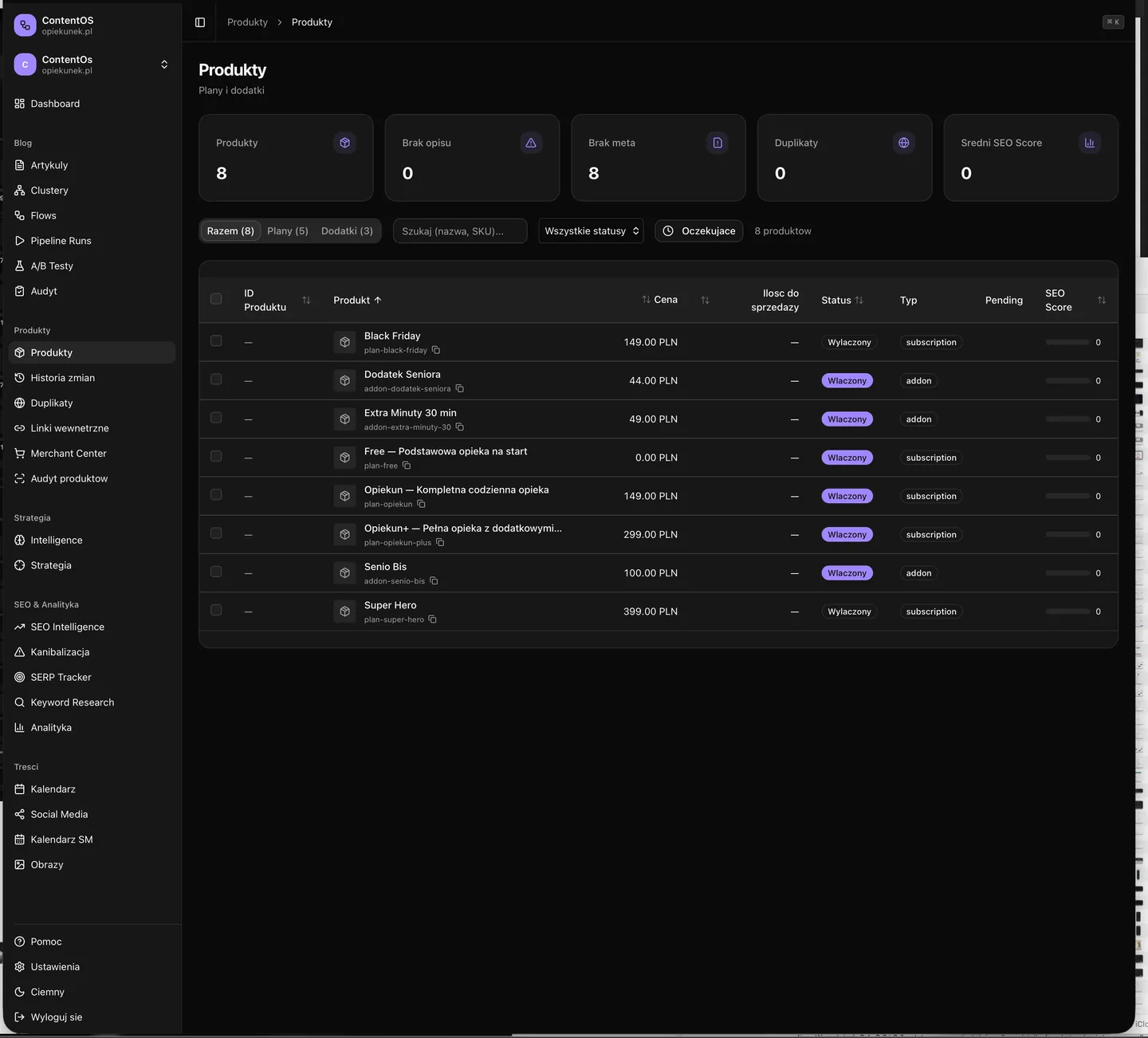
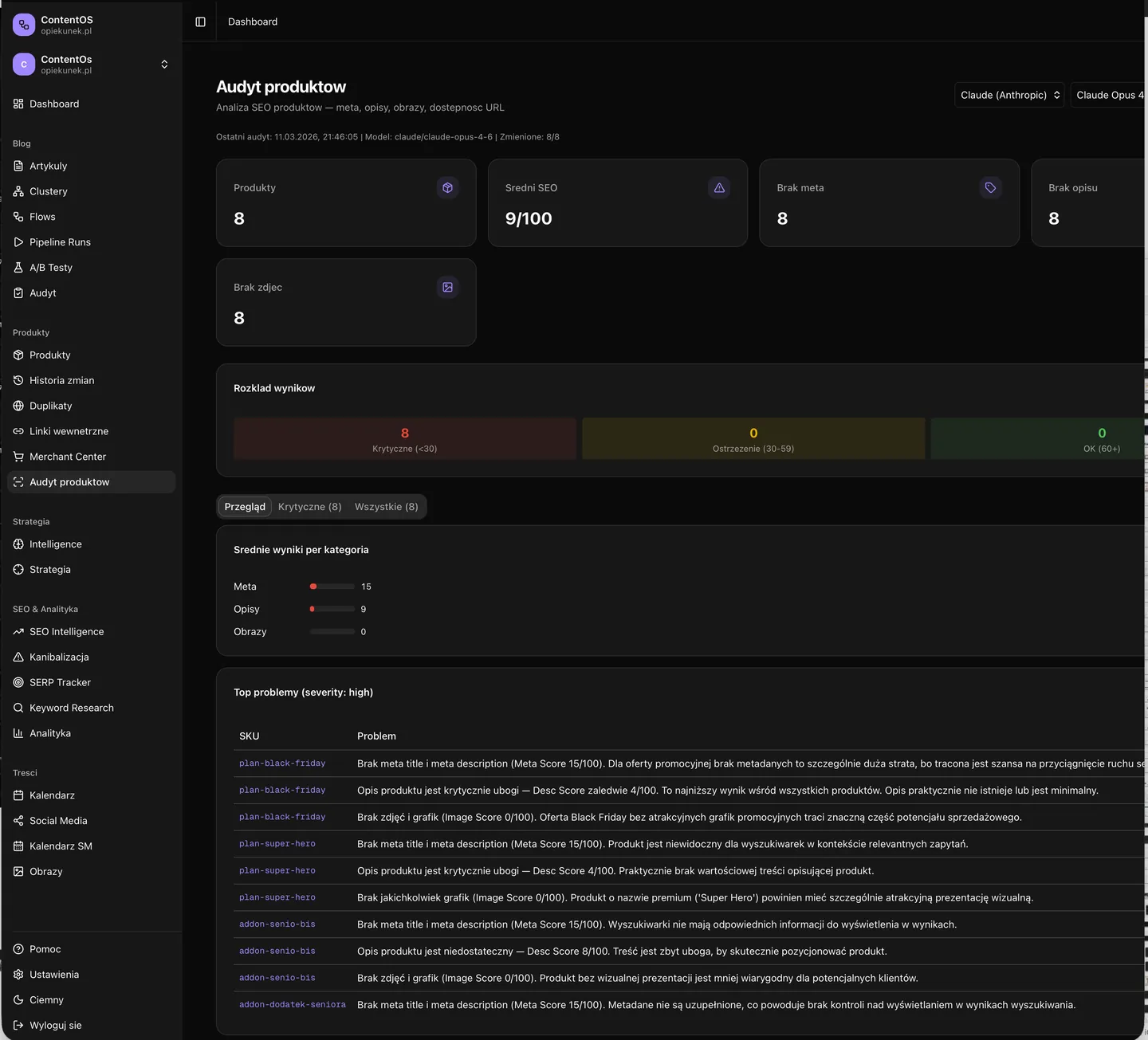
ContentOS imports products straight from Magento (11 products in the screenshot — Black Friday, Senior Add-on, Extra Minutes, Carer, Senio.Bis and so on). The product audit detects critical omissions: no meta description, no description, no images, names that are too short. Every issue is clickable → a fix prompt goes to the AI.
contentos.studioapps.pl/produktyProducts · List
SAMPLE DATA
11 products from Magento · price · status · subscription/add-on · SEO score per product
contentos.studioapps.pl/produkty/audytProduct audit · SEO
SAMPLE DATA
11 products · SEO 9/100 · no meta · no description · no images · top issues by severity
Link Manager
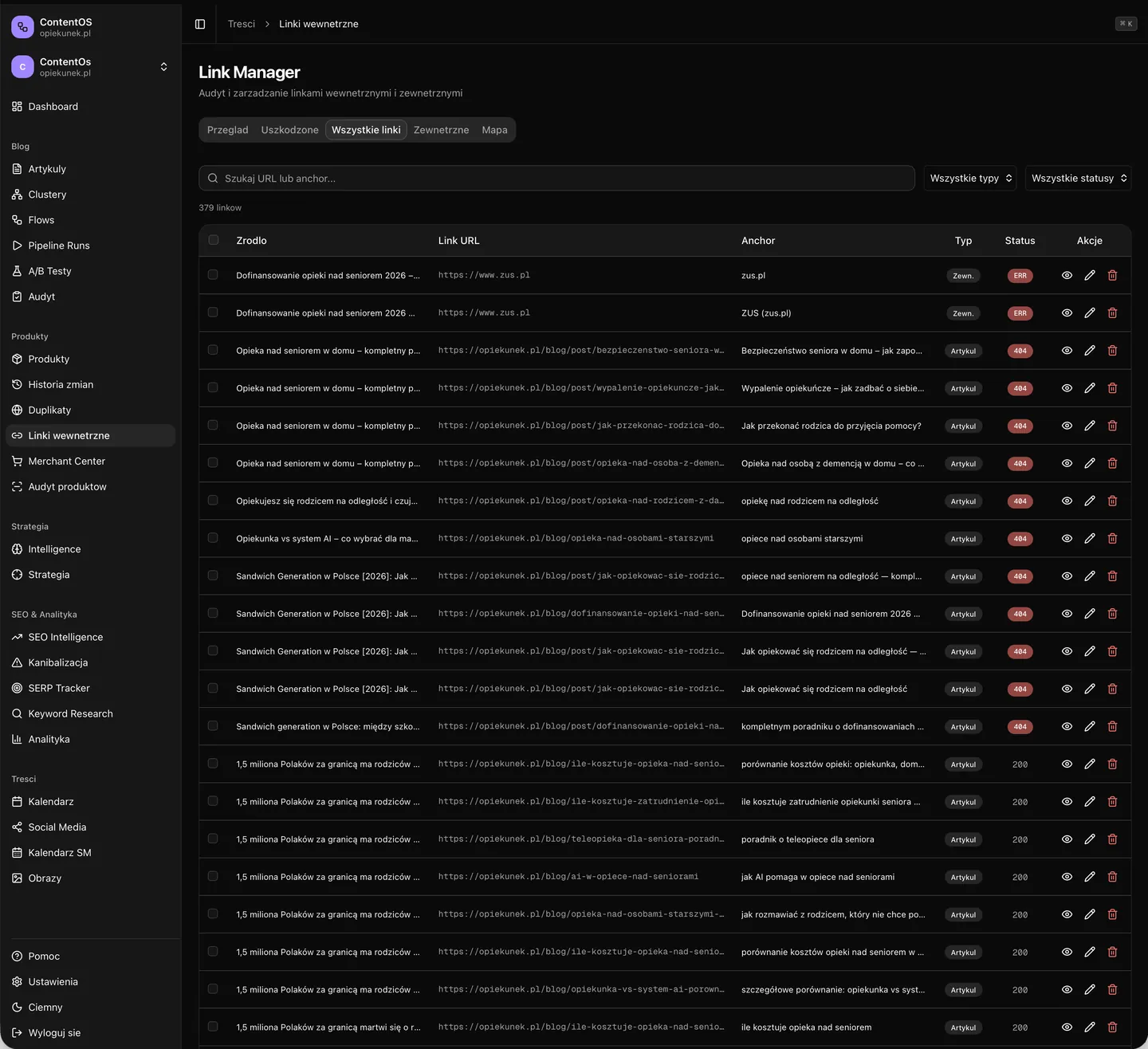
175 internal links under control.
The full link table: source, link URL, anchor, type (article / product / category), status. The AI suggests new links based on per-field similarity (title + intro + body scored separately). You can insert links in bulk or run a "Link Audit" — it checks for broken links and duplicate tracking.
SAMPLE DATA
175 links · source → target · anchor · type · status · per tenant · broken-link audit
Social Media
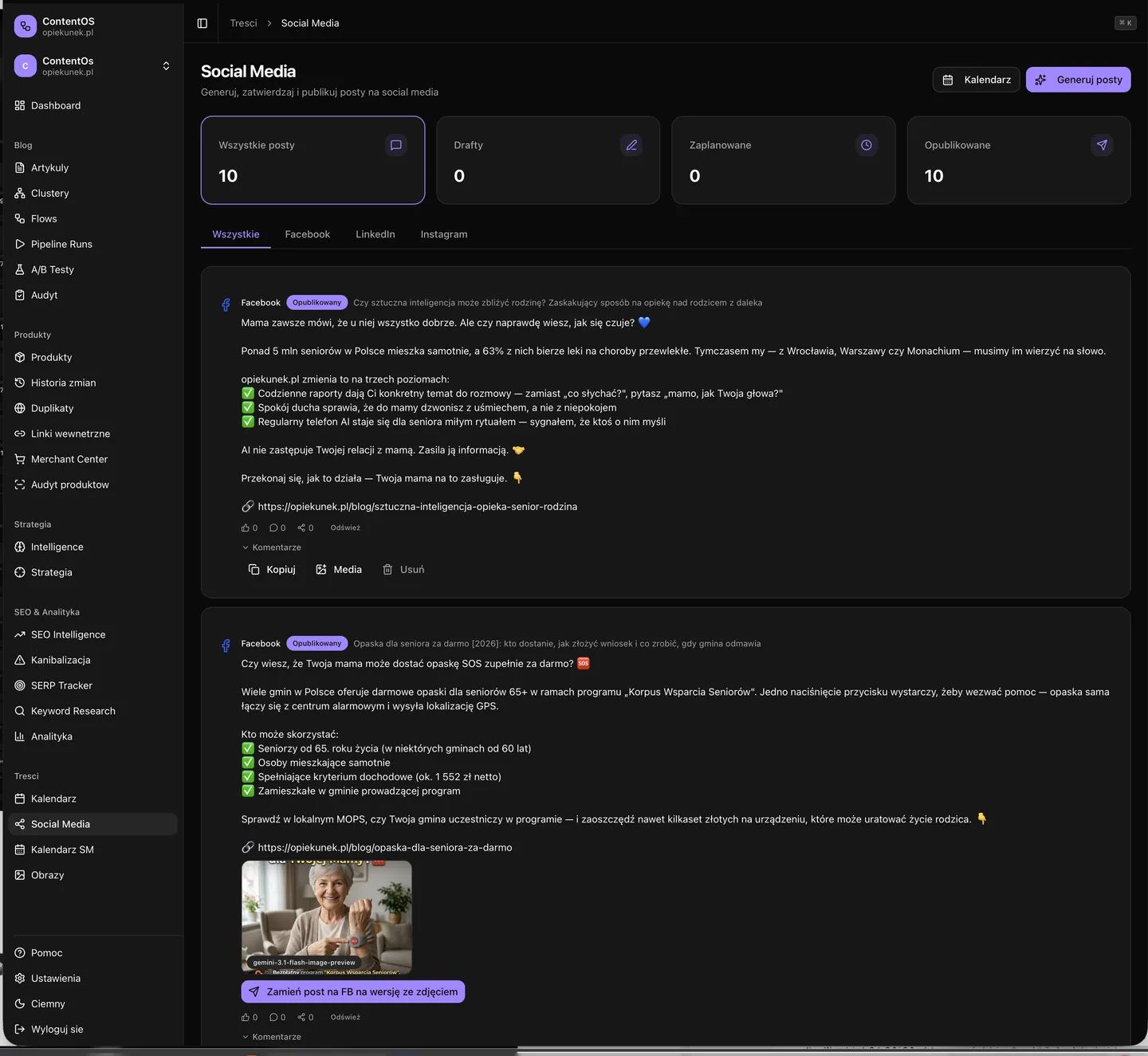
Every article generates FB / LinkedIn / Instagram posts.
Once an article is published, ContentOS automatically generates post variants for Facebook, LinkedIn and Instagram — with emoji, hashtags, a CTA and an image. You can approve, edit or reject each one. Auto-publishing to a Facebook Page runs through the Facebook Page MCP API.
contentos.studioapps.pl/socialSocial Media · Posts
SAMPLE DATA
10 posts · drafts / scheduled / published · FB Page MCP API · per-platform variants
Media Library
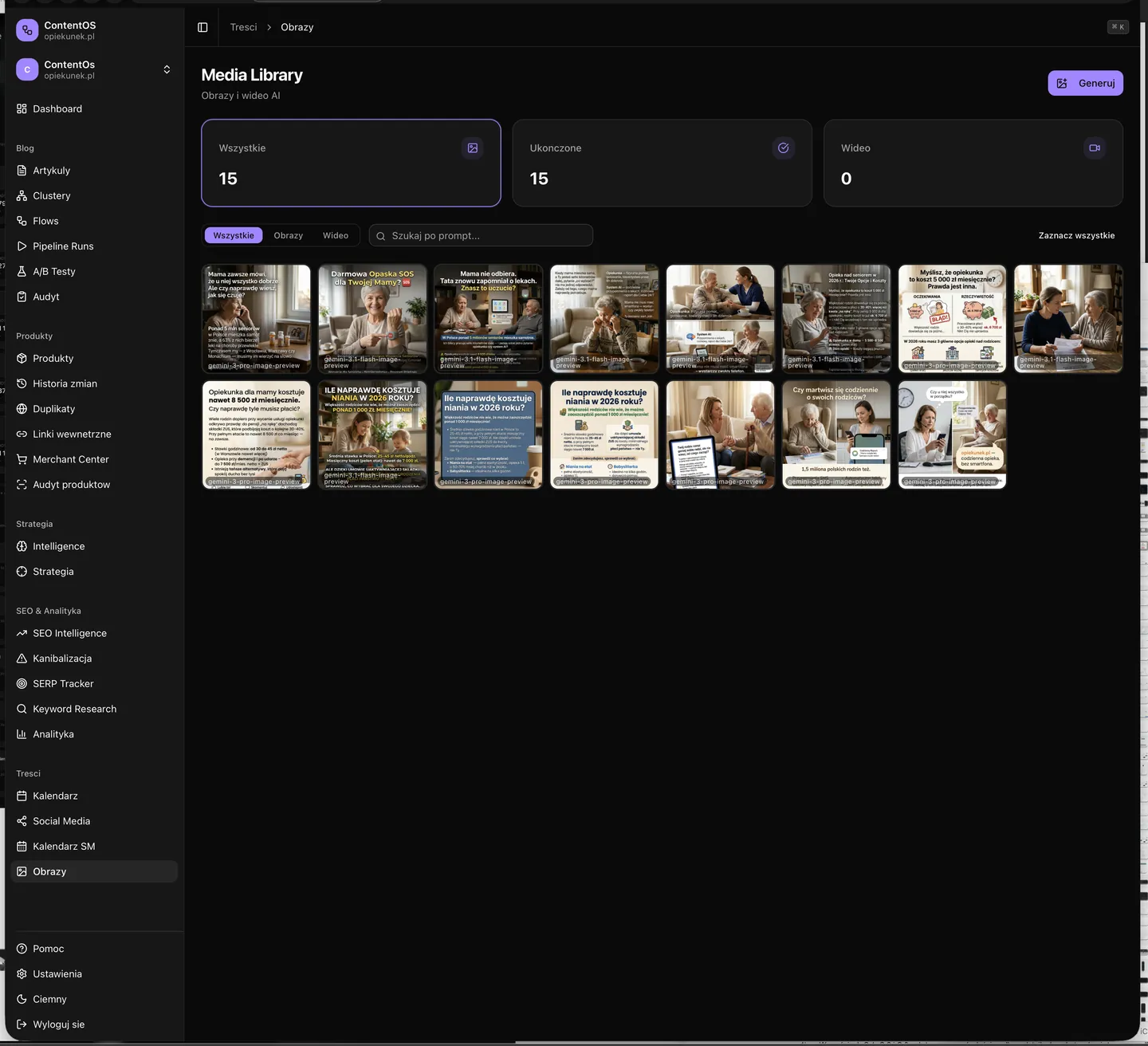
Every AI image in one place.
Each article generates a featured image plus in-article images automatically (Gemini text-to-image + Higgsfield image-to-image). All assets in one gallery, per tenant. You can upload your own, generate new ones from a prompt, clone and edit.
contentos.studioapps.pl/media-libraryImages · Media Library
SAMPLE DATA
15 generated images · Gemini + Higgsfield · per tenant · 24 sidebar sections
5 AI models
Every provider does what it is best at.
ContentOS pulls the available models dynamically from each provider's /api/models. A new model ships — it appears in the dropdown. Switching provider mid-flow is one click, no deployment.
C
Claude
Opus 4.6 · Sonnet 4.6
Editing, natural prose, long context. Default choice for Polish and German copy.
G
Gemini
2.5 Pro · Flash
Drafting, long articles, text-to-image. Cheapest at 100k+ tokens.
GPT
GPT
GPT-5 · GPT-5 mini
SEO meta tags, reasoning, structured outputs. Fallback for edge cases.
𝕏
Grok
Grok-4
Realtime web + X (Twitter) signals. Trending topics, news angles.
P
Perplexity
Sonar · Sonar Reasoning
Real-time research with citations. Default choice for fact-finding and competitor analysis.
Features
What ContentOS does that Jasper and Surfer do not.
Most content marketing tools stop at "generate a draft". ContentOS goes further — it publishes, measures, optimises and checks for cannibalisation. Because we built it for ourselves, as an agency running 8 industry blogs.
AI pipeline, step by step
You choose provider + model + prompt for every step of the flow. Research on Perplexity, draft on Gemini, editing on Claude — or any other combination. Save a preset per content category.
Auto-publishing to Magento
One click publishes to the right store view with the correct slug, the featured image in pub/media/ and an HTML wrapper. Supports 6 Magento instances plus a webhook to Next.js.
Site Intelligence
A crawl of the client's site and blog, an AI-generated brand profile, context injected into every prompt. The article "knows" where it will be published — brand voice, target market, linking policy.
Cannibalisation detector
Three layers: URL similarity, embedding similarity, query overlap from Google Search Console. It shows where two articles are fighting over the same phrase — before publication, not six months later.
Two-way internal linking
Suggests links based on per-field similarity (title + intro + body scored separately). It updates older articles by adding links to new ones. Built-in anchor-text rules for brand and commercial terms.
Image generation
Gemini text-to-image for featured and in-article images. Higgsfield image-to-image to place the client's products in a new setting — boiler room, delivery, warehouse. No stock photos of people in suits.
A/B tests for meta tags
Per-tenant A/B testing of SEO meta with CTR tracking in GSC. After 30 days the system picks the winning variant automatically. It takes "I think this sounds better" out of SEO optimisation.
Content Calendar + SERP tracker
A publishing calendar showing which phrases are already in the pipeline. A SERP rank tracker per country with alerts when positions drop. A bulk product editor for shops (Magefan + Magento PRD).
Multi-tenant with RLS
8 tenants in production. Each has its own brand context, its own integrations and its own API keys for the AI providers. Postgres Row Level Security — zero crosstalk, zero chance of a leak between clients.
Architecture
One database. 8 tenants. Zero crosstalk.
Postgres with Row Level Security on every table. Every query is filtered automatically by tenant_id. The per-tenant site context is injected at runtime into every AI prompt.
9 integrations
Every integration works, and every one has been fixed at least once.
9 integrations in production. Some are simple (REST), some are a nightmare (Magefan returns string-in-string JSON, reports errors as HTTP 200, and produces slug conflicts across stores). Every one of them has been repaired — the commit history proves it.
G
Google Search Console
daily sync · queries · ctr · positions
A
Google Analytics 4
traffic · conversions · funnels
M
Google Merchant
product feed · price competition
M
Magento × 6
6 instances · 4 brands · 3 countries
M
Magefan Blog
PUT articles · slug · featured img
f
Facebook Page
auto-post · insights · comments
○
Next.js webhook
Next.js blog · MDX · ISR
I
Inngest Workflows
14 functions · cron · durable retry
"8 domains, 5 AI models, one publishing API. Content goes from research into Magento with no spreadsheets and no copy-paste."
ContentOS · production · 318 commits · 2.5 months
Stack
What ContentOS is built from.
The standard StudioApps stack plus Inngest for durable workflows instead of cron and a Redis queue. Inngest gives you retries per step, observability and replay — and there is no Redis to maintain.
Next.js 16
App router
React 19
RSC
TypeScript
strict · 72k LOC
Supabase
Auth + RLS
PostgreSQL
36 tables
Inngest
Durable workflows
Tailwind 4
Styling
5 AI providers
Swappable live
Higgsfield
Image-to-image
Vercel
Auto-deploy main
Magefan API
Magento blog
pgvector
Embeddings
Honestly
What ContentOS does not have today.
ContentOS is an internal tool — we do not sell it as SaaS. There is no public onboarding, no billing, no plans. Active users: around 3 (the StudioApps team). The 8 tenants are clients under NDA plus our own brands.
By designNo public sign-up / billing / Stripe. An internal tool with invitations for partners. Roadmap: a SaaS tier for partner agencies.
LimitationThe interface is Polish-only (the content it generates is PL and DE). An English UI is on the roadmap — not a blocker, because we are not yet targeting English-speaking clients.
RoadmapA WordPress connector is in the backlog. Today it is Magento only (Magefan API) plus the Next.js webhook. WP needs its own mapper because the database structure differs.
RoadmapNo SOC 2 or formal GDPR audit. We do not sell to enterprise (yet). The stack is EU-only regardless (Supabase EU, Vercel EU region).
LimitationNo sales landing page. A login screen and a dashboard. Everything sits behind auth. Roadmap: a marketing site alongside the SaaS tier launch.
DeliberateNo race for "writer credits". ContentOS has no "100 articles a month for X" plan. It is a pipeline — you pay the AI costs directly to the providers.
Running blogs for 5+ clients? We will show you live.
ContentOS is our internal tool today — but we are opening it selectively to partner agencies. A no-obligation call: 30 minutes, a screenshare from our production account, a real pipeline running on live domains.