An internal StudioApps tool for creating, managing and uploading 1,000+ products into multi-store Magento instances. From scraping a PDF catalogue, through AI enrichment of descriptions and translations, to a batch REST API push across 6 domains at once. An e-commerce manager drops in 100 products in the morning — and ends the day with live stock in 3 countries.
Status
● Production live
Public name
SKU Generator
Magento stores
6 instances · 3 countries
Stack
Next.js 16 · Supabase · Claude + Gemini
Cost
€0 hosting · API per token
Magento synchronisation
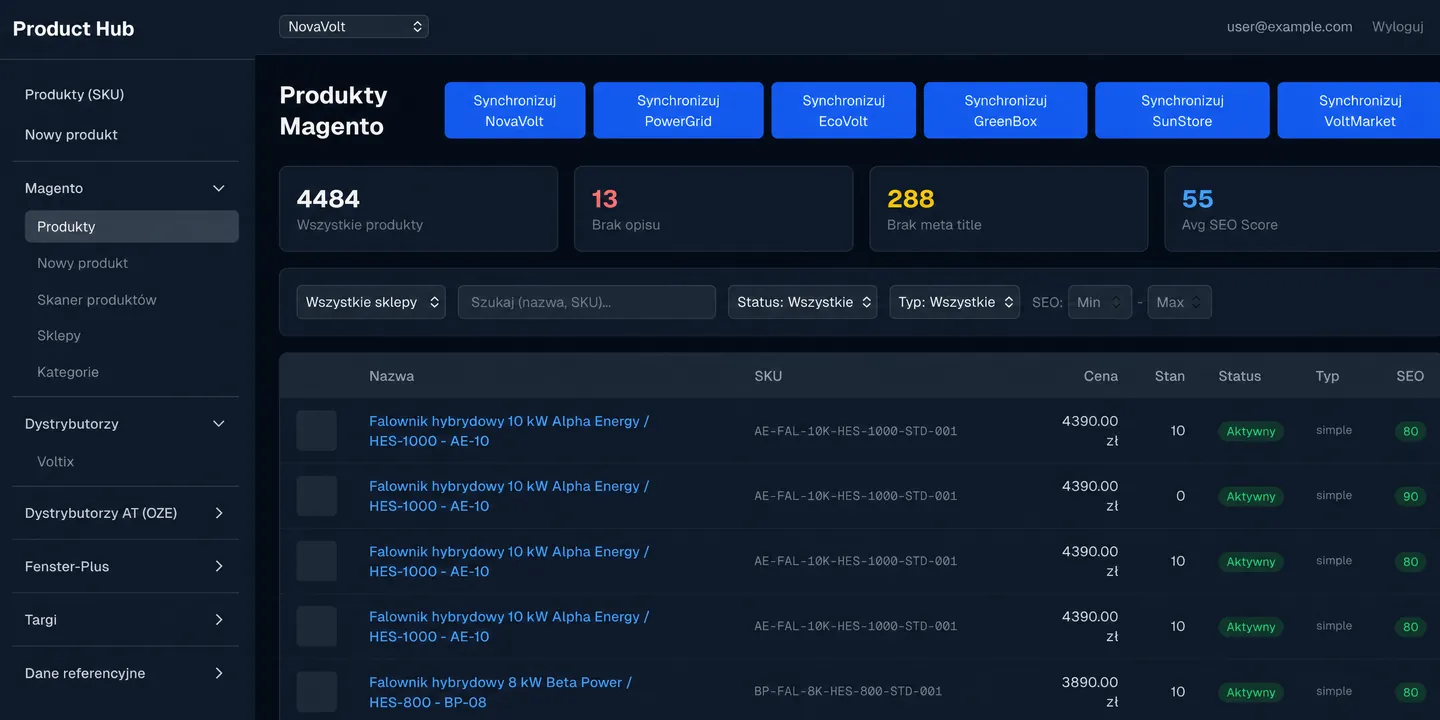
Six stores. 4,484 products. One audit.
A store switcher at the top of the panel — 6 Magento instances (PL/AT/DE) as tabs. Every click gives you a full product inventory with an SEO score per product. 4,484 products live across the stores · 13 missing descriptions · 288 missing meta titles · 55 average SEO score — you know straight away what to fix this week. (4,484 = active products across all 6 Magento instances. 1,064 = unique SKUs in the PIM database — because the same product often appears in several stores.)
SAMPLE DATA
6 Magento stores · 4,484 products · live SEO audit · stores anonymised (NovaVolt / PowerGrid / EcoVolt / GreenBox / SunStore / VoltMarket)
Product numbers
What Product Hub does in the background.
Numbers taken from a genuine agent report on the live project — verifiable under NDA. As of 2026-05-06.
6
Magento stores
PL · AT · DE
1,064
SKUs in the database
format: PRD-XXX-YYY-NNN
2
Dual-provider AI models
Claude + Gemini
4
Scraper layers
JSON-LD → OG → HTML → fallback
244
TypeScript files
Next.js 16 · Supabase RLS
Per-distributor inventory
Every distributor — its own portfolio, its own categories.
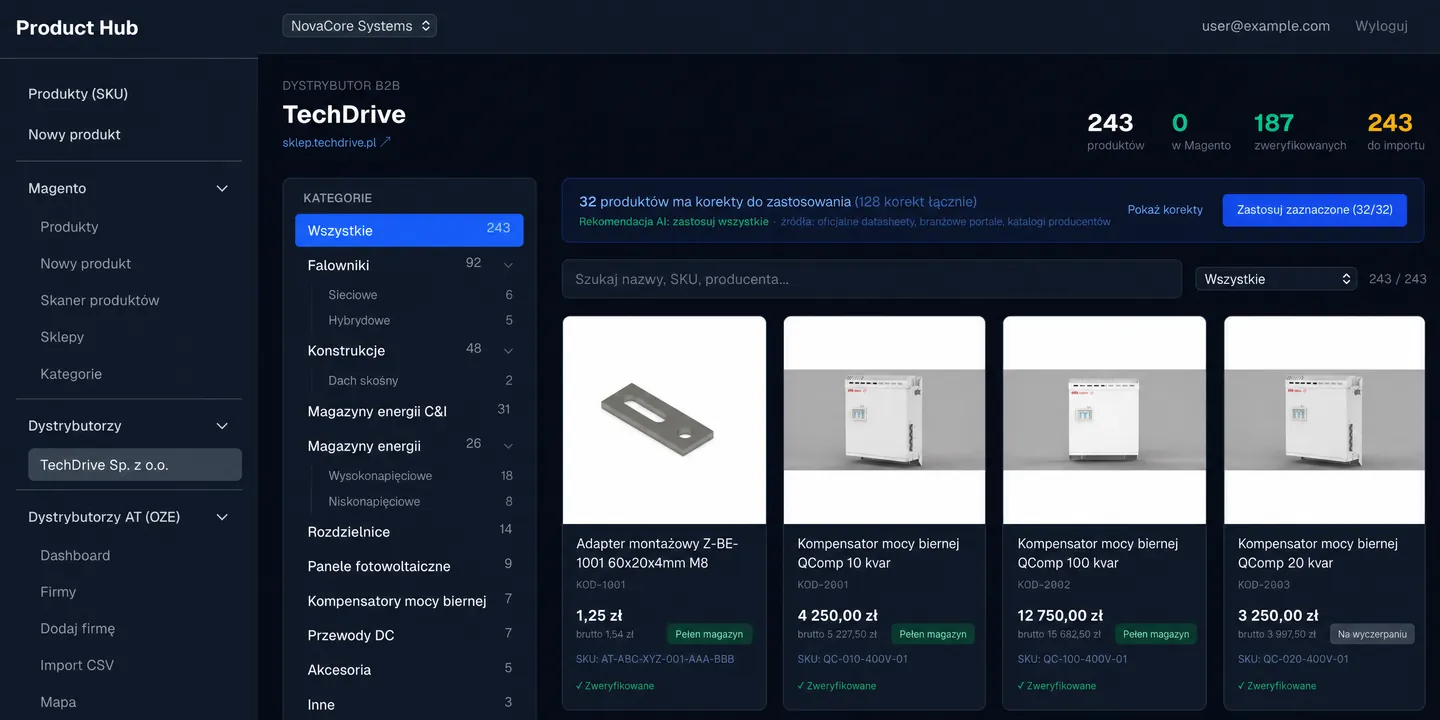
The Magento stores are full, but where do the products come from? From distributors. Each distributor (TechDrive, Solarex, NovaCore Systems, NovaEnergy) has its own product portfolio with categories in Product Hub: Inverters, Mounting systems (Pitched, Hybrid), Energy storage, Switchgear, PV panels, Reactive power compensators, DC cabling, Accessories. Click "Energy storage (12)" in the sidebar category tree → you see only the products in that category from that distributor.
SAMPLE DATA
243 products in TechDrive · 0 pushed to Magento · 187 approved · category tree with live counters
Product pipeline
From PDF catalogue to Magento — in 6 steps.
The operator never copies data by hand. They drop in a PDF / URL / Excel file → Product Hub fires up a 4-layer scraper + AI enrichment + Magento push. Job-based architecture with a retry on every step.
01 · INPUT
PDF
Upload
PDF · URL · CSV
02 · SCRAPE
L1-4
4-layer
JSON-LD → OG → HTML → fallback
03 · VISION
CV
Vision AI
Claude on spec tables
04 · ENRICH
AI
AI Enrichment
Claude + Gemini copy + SEO
→
05 · SKU
SKU
Generator
unique, per-store
06 · PUSH
M2
Magento push
REST · 6 stores · batch
SKU generator
1,064 unique codes. A structured format.
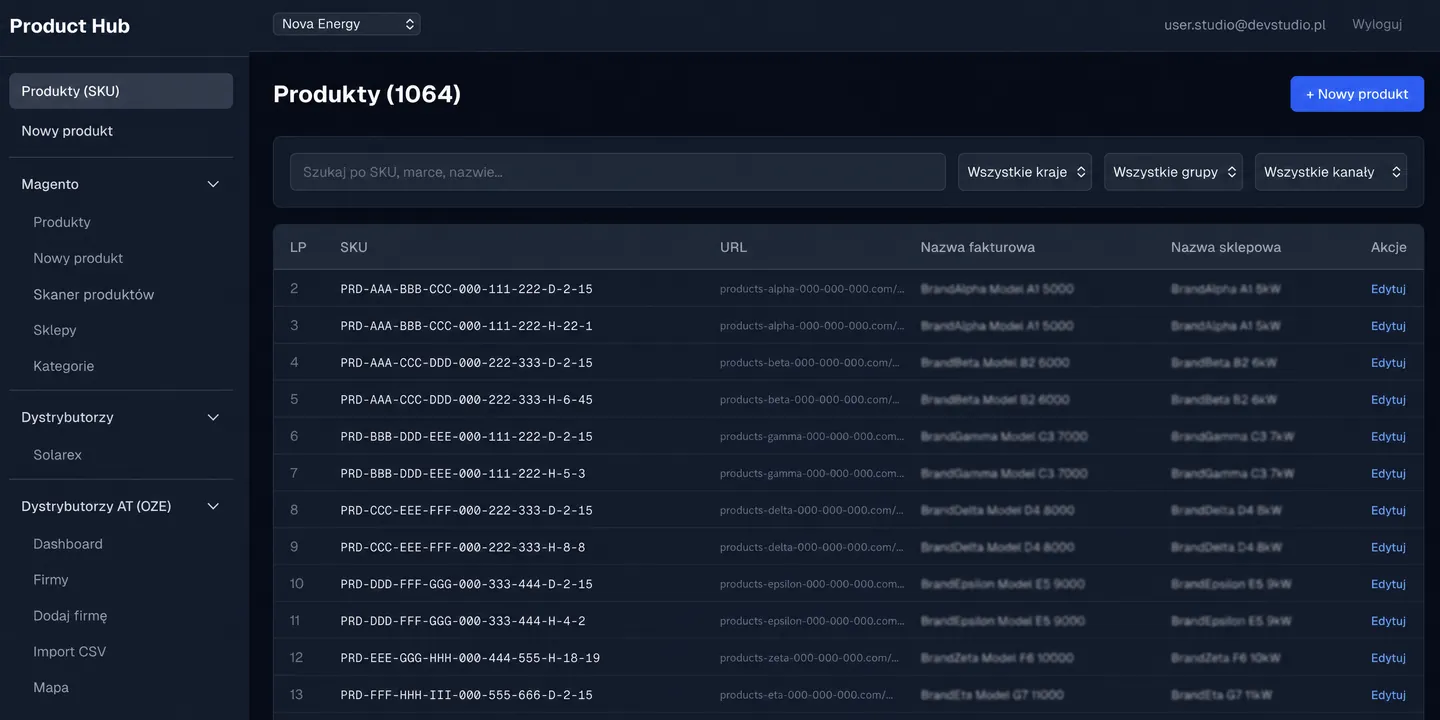
Every product gets a unique SKU following the pattern PRD-AAA-BBB-CCC-000-111-222-D-2-1S — category, distributor, brand, attribute, variant. Click a SKU → the full mapping: production URL, invoice name (for invoicing), store name (for Magento), change history.
product-hub.studioapps.pl/skuProducts · SKU list
SAMPLE DATA
1,064 SKUs · PRD-AAA-BBB format · URL + invoice name + store name · filters: country / group / channel
What Product Hub can do
Features for an e-commerce manager.
Designed for a product manager handling multi-supplier dropshipping plus seasonal imports. 1,000+ SKUs per season in 2-4 country versions. No spreadsheet mafia, no "copy-paste from the PDF".
PDF auto-parsing with Vision AI
Upload PDF catalogues → automatic text extraction + base64 images → Claude vision on the specification tables. Dimensions 80×120×60 cm, Weight 15 kg, Output 5 kW — pulled automatically out of the supplier's PDF.
4-layer scraper
JSON-LD (structured data) → OpenGraph (meta tags) → HTML parsing → AI fallback. Every supplier site is built differently — the scraper burns through all 4 layers until it gets the data out.
Dual-provider AI enrichment
Claude (long descriptions, natural prose) + Gemini (PL/DE/AT translations, cheaper above 100k tokens). Provider swap at every pipeline step — the operator decides.
Magento REST multi-store
6 Magento stores (3 B2C brands × PL/AT/DE markets + 2 DACH stores + 1 AT — stores anonymised in the UI). Pushes products, categories, inventory and prices. SKU uniqueness per store, attribute_set_id per country.
Job-based architecture
scrape_jobs, ai_enrichment_jobs and magento_product_edits tracked in the database. Retry logic on every step (3 attempts), status monitoring, an audit trail per operation. Who did what and when — always on record.
Category tree per distributor
Each distributor has its own category portfolio (Inverters, Mounting systems, Storage, Switchgear, PV, Compensators, Cabling, Accessories) with live counters. Mapped onto store-specific Magento categories.
Live SEO audit
Per store and per product: missing description, missing meta title, missing images, SEO score 0-100. A "Quick Wins" list — products one point away from the top 3 in the SERP. Fix prompt in one click.
Shared Supabase RLS
Product Hub lives in the same database as Fenster-Haus and AT Installers. Row-level security per table — sku_entries read-only for AT Installers, at_installers read-only for the Hub. Zero crosstalk, one quota.
Structured SKU format
PRD-AAA-BBB-CCC-000-111-222-D-2-1S = category (3) - distributor (3) - brand (3) - attribute (3) - 3 numeric segments - variant - size - option. Every SKU tells you what it stands for.
6 Magento stores
Multi-store, multi-country, multi-language.
Product Hub manages products for 6 Magento instances across 3 markets — all under NDA, the clients require anonymity. The stores are shown under fictional names in the UI.
🇵🇱
B2C store PL #1
pellets · Magento 2.4 + Hyvä 1.4
🇦🇹
B2C store AT #1
pellets · multi-country Magento
🇩🇪
B2C store DE #1
pellets · multi-country Magento
🇵🇱
B2C store PL #2
accessories · Magento 2.4 + Hyvä
🇦🇹
B2B store DACH
PV · Magento + Magefan Blog
🇦🇹
B2C store AT #2
PV · separate Magento instance
"Push 100 products into Magento instead of adding them one by one — a 4-layer scraper, AI descriptions and translations, batch push with retry logic."
Product Hub · production · multi-tool platform
Stack
What Product Hub is built on.
The standard StudioApps stack. Product Hub runs on the same Vercel deployment and Supabase project as Fenster-Haus and AT Installers — 3 products in one deployment, hosting cost zero.
Next.js 16
App router
React 19
UI
TypeScript
strict · 244 files
Supabase
Shared RLS
PostgreSQL
Jobs + audit
Tailwind 4
Styling
Claude API
Vision + copy
Gemini API
Translations
Magento REST
6 stores
pdf-parse
PDF extract
Vercel
Hobby tier
shadcn/ui
Components
Honestly
What Product Hub does not have yet.
It has been running in production for months, but not everything is finished. Some things exist as backend functions with no UI on top. Others are on the backlog — we do not pretend otherwise.
Backend OKUI for creating products in Magento — the createMagentoProduct() function exists in the code but is not wired up to the interface. The operator has to export as JSON and upload through the Magento admin.
UI gapBatch operations UI — the magento-push/[productId] endpoint handles one product at a time. There is no spreadsheet view with a bulk "Upload all" button.
RoadmapWordPress / WooCommerce connector — Magento REST only. The WooCommerce REST API would be about 3 days of work.
By designNo SaaS plan. Internal tooling for StudioApps and Magento clients under NDA. A rollout for a new client is quoted individually — it depends on the number of stores, the data sources and the scope of the integrations.
LimitMulti-supplier matching — the same product from different distributors still needs mapping by hand. On the roadmap: fuzzy matching on attributes.
DeliberateNo public landing or marketing site. A login screen and a panel. This is an internal tool, not a product sold off the shelf.
Managing 1,000+ SKUs in Magento? We will show you live.
A no-obligation conversation: 30 minutes, a screenshare from production, and you will see us push 100 products into 6 stores in half an hour instead of a week.